Introduction to Recursion (1)
Course: Recursion - chapter 1
What is Recursion?
Section titled “What is Recursion?”
A function calling itself (with different parameters) is called recursion.
For example: f(n) = f(n-1) + f(n-2) is an example of recursion.
Visual Representation (Recursion Tree)
Section titled “Visual Representation (Recursion Tree)” fib(6) / \ fib(5) fib(4) / \ / \ fib(4) fib(3) fib(3) fib(2) / \fib(3) fib(2)Function call stack
Section titled “Function call stack”A question that can come to your mind: How does this work? How does fib(3) know that the control has to return to fib(4)? How are the function states maintained?
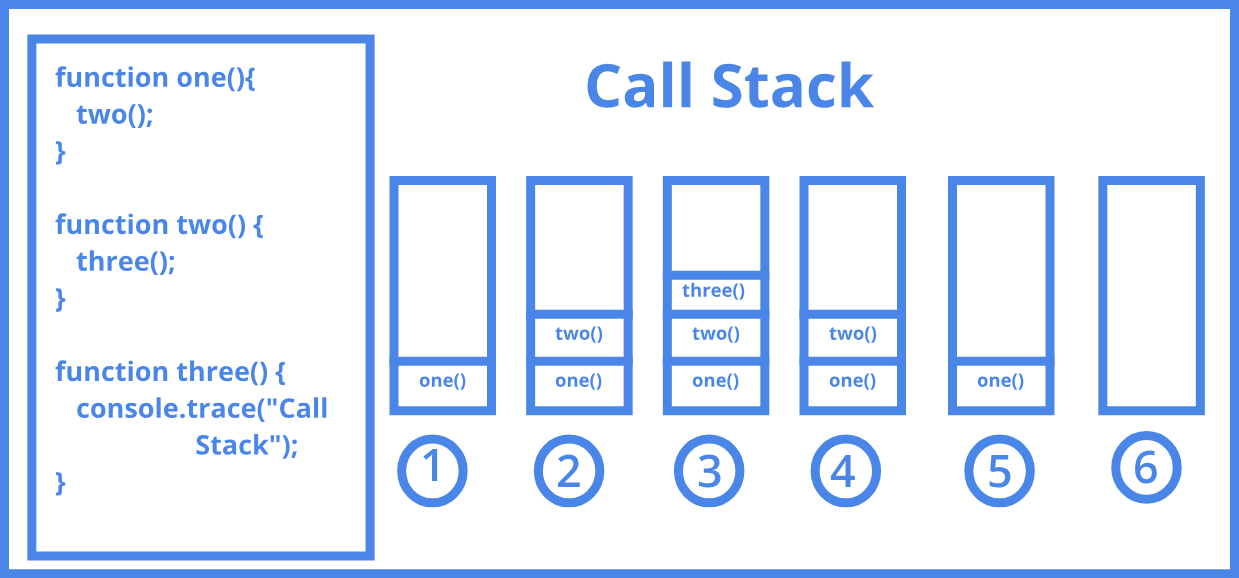
We can do recursion because of the stack memory.
Structure of a recursive function
Section titled “Structure of a recursive function”- **State: **States are the function parameters that change during the recursion. For example, in the case of Fibonacci numbers
fib(n), n is the state as it changes during every recursive call. - Base condition: These are very important to terminate a recursion. Otherwise, the recursion would continue infinitely leading to stack size limit exceeded errors. A base condition is hardcoding the answer for some values of the state (generally smaller values) which we can calculate manually.
- Transition: We can call it a subproblem, recursive call, or transition. It is basically how a state depends on other states to calculate its value. Or, calling the next states from the current state.
Complexity Analysis
Section titled “Complexity Analysis” fib(n) -> 2^0 / \ fib(n-1) fib(n-2) -> 2^1 / \ / \ fib(n-2) fib(n-3) fib(n-3) fib(n-4) -> 2^2 . . . fib(0) fib(1) fib(0) fib(1) fib(0) fib(1) ... -> 2^nWhat is Recursion?
Section titled “What is Recursion?”
A function calling itself (with different parameters) is called recursion.
For example: f(n) = f(n-1) + f(n-2) is an example of recursion.
Visual Representation (Recursion Tree)
Section titled “Visual Representation (Recursion Tree)” fib(6) / \ fib(5) fib(4) / \ / \ fib(4) fib(3) fib(3) fib(2) / \fib(3) fib(2)Function call stack
Section titled “Function call stack”A question that can come to your mind: How does this work? How does fib(3) know that the control has to return to fib(4)? How are the function states maintained?
We can do recursion because of the stack memory.
Structure of a recursive function
Section titled “Structure of a recursive function”- **State: **States are the function parameters that change during the recursion. For example, in the case of Fibonacci numbers
fib(n), n is the state as it changes during every recursive call. - Base condition: These are very important to terminate a recursion. Otherwise, the recursion would continue infinitely leading to stack size limit exceeded errors. A base condition is hardcoding the answer for some values of the state (generally smaller values) which we can calculate manually.
- Transition: We can call it a subproblem, recursive call, or transition. It is basically how a state depends on other states to calculate its value. Or, calling the next states from the current state.
Complexity Analysis
Section titled “Complexity Analysis” fib(n) -> 2^0 / \ fib(n-1) fib(n-2) -> 2^1 / \ / \ fib(n-2) fib(n-3) fib(n-3) fib(n-4) -> 2^2 . . . fib(0) fib(1) fib(0) fib(1) fib(0) fib(1) ... -> 2^n